
Walk inside almost any typical gym around five in the evening. It always smells the same. Stale sweat, chalk dust, and rubber floor mats. You hear iron clanging against metal racks, and people are grunting through back squats until their knees give out. For decades, we’ve been told the same old story. If you want a tough frame, you gotta load up a bar, grit your teeth, and beat your joints to a pulp.
Trouble is, half the people doing that end up walking around stiff as a board. Their lower backs ache when they get out of bed. Their knees twinge every time they take the stairs. Real strength isn’t just about how much dead weight you can heave off a floor. It’s about how you carry your life. It’s lifting a heavy sack of mulch into the trunk without throwing your spine out of whack. It’s wrestling with your kids on the rug or hiking out near Government Canyon on a hot Saturday morning without feeling crippled the next day.
That is why so many folks are checking out Pilates studios in San Antonio. It isn't just stretching on a mat. Done right, it builds a deep, unbreakable foundation that supports everything else you do.
Big Muscles Don’t Mean Much If Your Joints Hurt
Most folks look at gym culture and think strength equals size. You see the usual bodybuilding split: chest day on Monday, arms on Tuesday, legs on Thursday. The human body is not a sequence of well-defined slices.
Your body reacts as a whole the next time you slip on wet limestone or lean to the side to reach for the umbrella in the back seat. The larger muscles overcompensate if the small muscles around the hips and spine are not functioning properly. Injuries can creep up on you.
Why traditional lifting can sometimes leave you feeling beat up:
What the 5 Pillars of Functional Wellness Look Like in Real Life
Muscle is great, but what good is having big arms if you can’t twist around to back out of a driveway without a grimace? Over at inBalance, training is shaped around five everyday pillars that keep you moving well into your retirement years:
When you train all five together, you stop feeling fragile. You feel capable.
What Happens When You Get On a Reformer
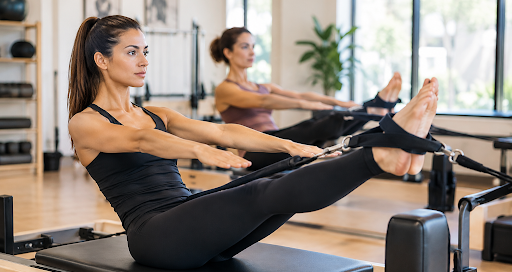
If you’ve never seen a Pilates reformer, it looks a bit strange from a distance. Leather straps, sliding wooden carriages, and a rack of coiled metal springs. People look through the studio window and assume it’s an easy, gentle workout. Then they get on one. The teacher tells them to hold a lunge while the carriage tries to slide away. Thirty seconds in, their legs start shaking like a leaf. That tremor isn't weakness. That’s your deep stabilizers waking up because they have nowhere left to hide.
Springs don’t work like dumbbells:
Springs pull harder the further you push them, forcing your muscles to stay under full tension the entire repetition.
You walk out of top San Antonio Pilates studios feeling weirdly tall. Your shoulders drop down away from your ears, and your stomach feels like a tightened corset.
Picking the Right Studio Matters More Than You Think
Not all classes are built the same way. You have probably seen those giant chain studios that squeeze thirty people into a dark room with neon lights and blast music so loud you can’t hear yourself think. The instructor stands on a podium shouting through a mic while half the room does sloppy reps with rounded backs. That’s an easy way to tear a shoulder cuff. Good movement requires an instructor who actually watches your spine. If you’re checking out pilates classes in San Antonio, pay attention to what's happening on the floor:
When someone with proper training watches your alignment, they spot when your hip rolls out, or your neck jams up before it ever hurts. That’s how you get real results without wrecking yourself.
Training Your Head While You Train Your Body
Most workouts let you completely tune out. You can sit on a stationary bike, scroll through social feeds on your phone, watch a muted sports game on the wall, and barely break a sweat. Pilates will not let you do that.
The second your mind wanders to what you’re making for dinner, you lose your balance on the carriage. You have to be completely locked in:
You stop leaving workouts feeling beat down and drained. Instead, you leave feeling clear-headed and energized.
Finding Your Groove at inBalance Studios
If you want the kind of pilates san antonio TX residents lean on to stay active and mobile, inBalance runs things differently. We don't believe in one-size-fits-all routines or giant, faceless workout rooms where nobody knows your name.
With neighborhood spots out in the Northwest area and Alamo Ranch, our spaces mix luxury equipment with a relaxed, boutique atmosphere where anyone can feel comfortable walking through the door.
Our instructors have put in hundreds of hours learning movement mechanics, anatomy, and hands-on adjustments. We blend reformer work, functional fitness, barre, and nutrition guidance so you keep progressing week after week. No matter your current fitness level, you will fit right in.
Ready to experience the benefits of Pilates?
Book Your Class Today!
Frequently Asked Questions
Are fitness studios in San Antonio open to beginners who have no fitness knowledge?
Yes, absolutely. Pilates studios in San Antonio that have a good reputation offer classes with a focus on novices who haven't been exercising for years or those recovering from previous injuries. The tension on the springs is adjustable with equipment (like the reformer) and allows instructors to increase or decrease the resistance to ensure your frame stays in place or to provide a challenge for the more advanced athlete. Basic concepts are introduced at a relaxed pace, free of judgment and pressure.
How often should I attend class to make progress?
Most will be able to see a physical difference within 2-3 weeks with 2-3 sessions per week. Your brain becomes accustomed to recruiting the underutilized core stabilizers, and your posture becomes much more improved. By Month 2, clients feel reduced back pain, ease in hip mobility, balance, and a toned-up midsection, arms, and legs.
Would enjoying Pilates reduce chronic stiffness in lower back and hips?
Yes, the majority of chronic back aches are the result of weak deep abdominals, sleepy glutes, and tight hip flexors due to sitting all day. Pilates works specifically on the transverse abdominis and pelvic floor to provide an internal corset for your lower back. As you begin to develop stamina, those stabilizing muscles begin to get stronger, and you don't need to strain in those joints anymore. The muscles that are used to stabilise them become stronger, and then there is no more strain in those joints; no more stiffness.
What is the main difference between reformer classes and mat classes?
There is no equipment involved and no leveraging on this exercise, meaning mat sessions are solely about body weight and gravity to build resistance, which means there is a serious need for personal control to not cheat on this exercise by doing reps. Sliding carriages, pulleys, and calibrated springs are used in the reformer classes. The reformer gives gentle support and progressive variable resistance to the tight joint and progressive resistance of the muscle throughout the range of its motion, deeper eccentric muscle contractions.
Does Pilates work for weight loss and body sculpting?
Pilates develops lean muscle, which will give your body a higher baseline metabolism, which will burn more calories even while you're at rest. Along with the regular classes and consistent functional training, interval formats, and daily balanced nutrition, you will noticeably shed fat, the outline of the waist will become more chiseled and defined, and you'll get an elongated and upright appearance that will make you look and feel slimmer.